 KH
KH  FR
FR  AR
AR CN
CNAn Seh Area: The Maps Establish the Facts, and Unauthorised Presence Cannot Create Sovereignty
AKP Phnom Penh, August 27, 2026 --
Cambodian Minister of Information H.E. Neth Pheaktra has in a Facebook message highlighted the Royal Government’s strong protest against the Thai Prime Minister’s unauthorised visit to the An Seh area, stressing that “the maps establish the facts, and unauthorised presence cannot create sovereignty.”
The full message published on Aug. 27 reads as follows:
“The Royal Government of Cambodia’s strong protest against the unauthorised visit by Thai Prime Minister Anutin Charnvirakul to the An Seh area, Cambodian territory, constitutes the exercise of Cambodia’s rights and responsibilities as a sovereign State to safeguard its sovereignty and territorial integrity, based on existing legal instruments, maps, and established facts.
The central issue that should not be diverted from the discussion is straightforward: Where is the An Seh area located?
The answer cannot be determined by political rhetoric, visits by senior officials, the planting of national flags, or the presence of military forces engaged in unlawful occupation. Nor can it be determined by maps unilaterally produced by either party. The answer must be found in the relevant conventions, treaties, boundary instruments, maps, and the survey and demarcation process grounded in a clear legal basis and conducted through mechanisms mutually agreed upon by both parties.
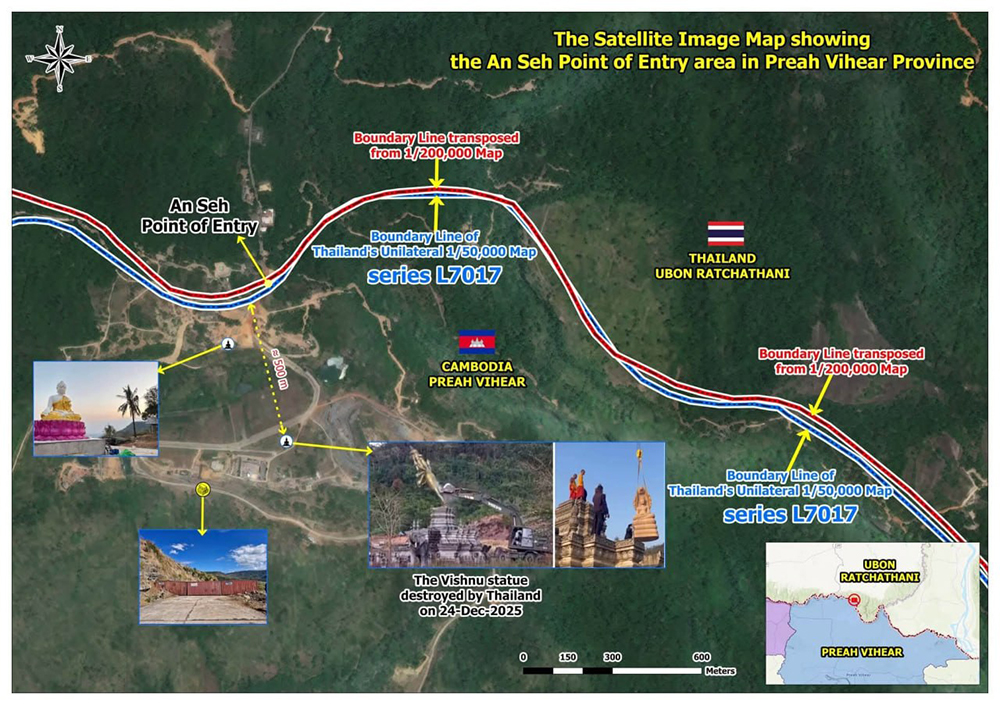
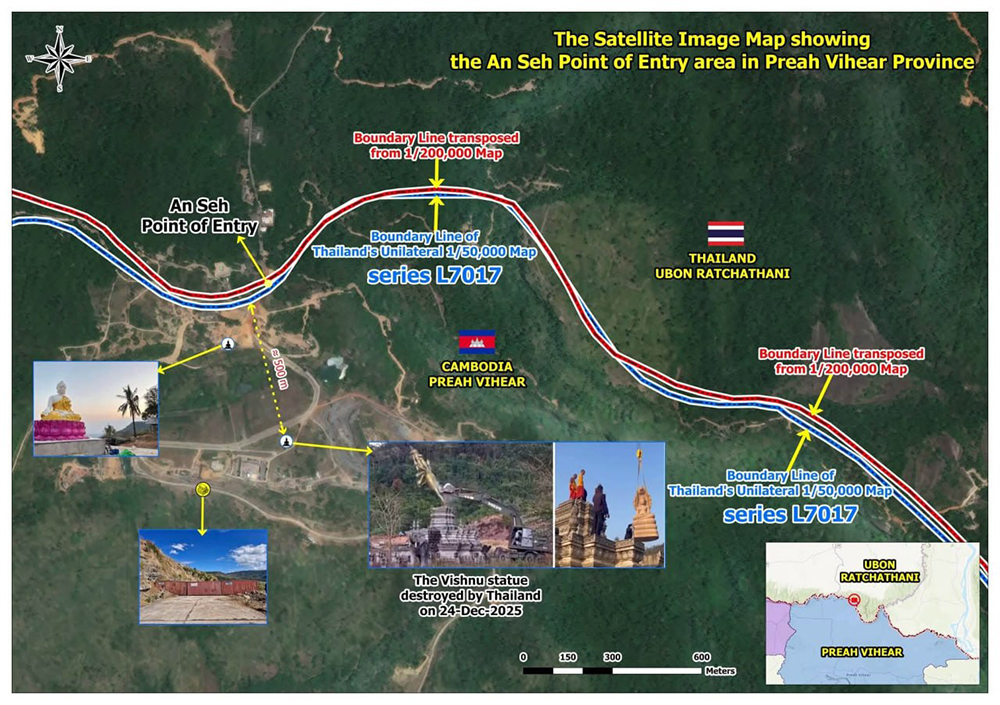
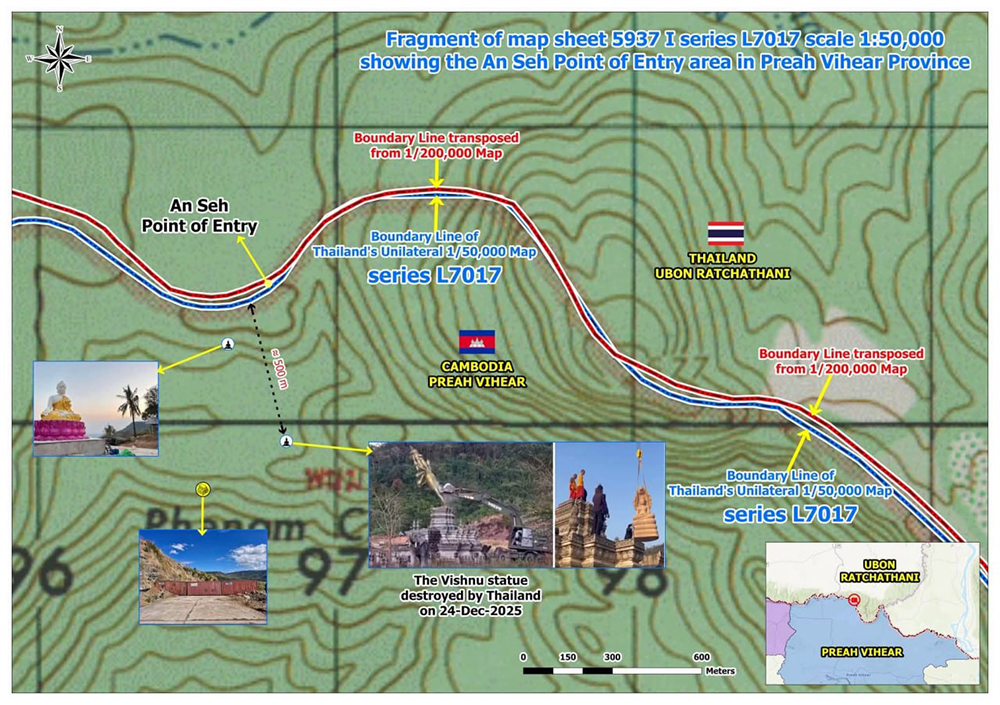
According to the State Secretariat of Border Affairs of Cambodia, the An Seh area is located in Choam Ksan district, Preah Vihear province, Kingdom of Cambodia. The 1:200,000-scale map resulting from the delimitation of the Indochina-Siam boundary pursuant to the Franco-Siamese Conventions and Treaty of 1904 and 1907 places this area within Cambodian territory. More notably, even Thailand’s unilaterally produced L7017 series map at the scale of 1:50,000 which Cambodia does not recognise as a legal basis for boundary delimitation-depicts the An Seh area on the Cambodian side of the line shown on that map.
This is a fact that requires an answer, not a diversion.
Words cannot create borders, and force cannot create borders. Unilateral claims cannot create sovereignty, and occupation by force cannot create sovereignty.
Shipping containers are not boundary pillars. Barbed wire is not an international boundary line. A national flag cannot transfer sovereignty from one State to another. The deployment of troops, construction of roads, or establishment of a physical presence on the ground cannot substitute for lawful boundary delimitation and demarcation. Nor can a visit by a prime minister transform an occupation lacking a legal basis into a lawful one.
This is the central point that the Thai side’s response cannot avoid. If Thailand maintains that it has not committed aggression against Cambodia, it should return the Cambodian territory that Thai forces have been and continue to unlawfully occupy, remove the barbed wire, and withdraw the shipping containers from Cambodian territory.
In particular, Prime Minister Anutin Charnvirakul’s visit cannot be invoked as a basis for creating or reinforcing Thailand’s claim of sovereignty over the An Seh area. A fundamental principle of law is that an unlawful act cannot generate lawful rights. The unauthorised entry of a senior Thai official into the An Seh area cannot conceal the encroachment upon Cambodian territory or cure the illegality of the situation arising from the unlawful occupation of Cambodian territory. Nor can it legitimise a fait accompli or alter the legal status of the territory.
Cambodia’s exercise of its sovereign rights and application of its laws in relation to activities occurring within its sovereign territory cannot be mischaracterised as a threat to use military force. The enforcement of law and the threat or use of force are two distinct matters, both legally and diplomatically. Conflating the two merely diverts the discussion from the facts and legal questions that must be addressed and serves only to obscure the unlawfulness of entering the territory of another State without authorisation.
Furthermore, occupying positions, erecting barriers, placing shipping containers, laying barbed wire, constructing infrastructure, planting flags, or bringing senior officials into an area to demonstrate presence cannot lawfully be used to create ‘new facts’ on the ground, a fait accompli, and then invoke that unilaterally created situation as a basis for sovereignty claims or for future boundary negotiations.
More importantly, any action capable of altering the situation on the ground must be assessed in the context of both parties’ obligations to prevent provocative activities, escalation of tensions, and changes to the status quo that could prejudice the boundary delimitation and demarcation process. Visits by senior officials to border areas at issue should not be used as political instruments to reinforce territorial claims or to create the perception that effective physical control is equivalent to sovereignty.
If the Thai side genuinely believes that the boundary must be determined by facts, law, and bilateral mechanisms, then the approach most consistent with that principle is to cease creating new facts on the ground, preserve the status quo, and return to the technical work and boundary mechanisms mutually agreed upon by both parties, rather than seeking delays or pretexts to avoid implementing existing agreements.
In particular, both parties must faithfully implement Point 3 of the Joint Statement of 27 December 2025, which states:
‘Both sides agree that all arrangements under this Joint Statement are without prejudice to the boundary demarcation and international boundary between the two countries. Both sides agree to task the Joint Boundary Commission to resume the survey and demarcation work at the earliest in accordance with the existing agreements between the two countries with the view to achieving lasting peace along the border… Both sides agree that the Joint Boundary Commission will accord the highest priority to the survey and demarcation work in the affected areas where civilians reside.’
The meaning is clear: boundary delimitation and demarcation must proceed through mechanisms mutually agreed upon by both parties, particularly the Joint Boundary Commission (JBC). Neither party should therefore create new situations on the ground and subsequently invoke those unilaterally created circumstances as a basis for determining the boundary.
Cambodia seeks peace and good relations with its neighbours. Cambodia supports the peaceful settlement of boundary issues through law, legal instruments, and mutually agreed mechanisms. But peace does not mean that Cambodia must silently accept infringements upon its sovereignty and territorial integrity. Nor does negotiation mean that one party may continue to occupy territory or create new facts on the ground while simultaneously calling upon the other party to return to the negotiating table.
The question, therefore, should not be: ‘Why is Cambodia protesting?’
The proper question is: ‘If Thailand respects negotiation, international law, and boundary delimitation through mutually agreed mechanisms, why does it continue to establish a presence and create new facts in an area that Cambodia has presented evidence as being within its sovereign territory?’
Maps cannot be changed by official visits. Borders cannot be changed by military presence. And sovereignty cannot arise from occupation by force.
The An Seh area must be addressed through law, maps, boundary instruments, and mutually agreed mechanisms-not through the creation of new facts on the ground.”
AKP